



Baguette Diamond Engagement and Wedding Rings
Baguette Diamond Wedding Bands and Engagement Rings
Featured Baguette Diamond Designs
The baguette diamond designs in this collection span eternity bands, tapered wedding rings, and matched wedding sets.
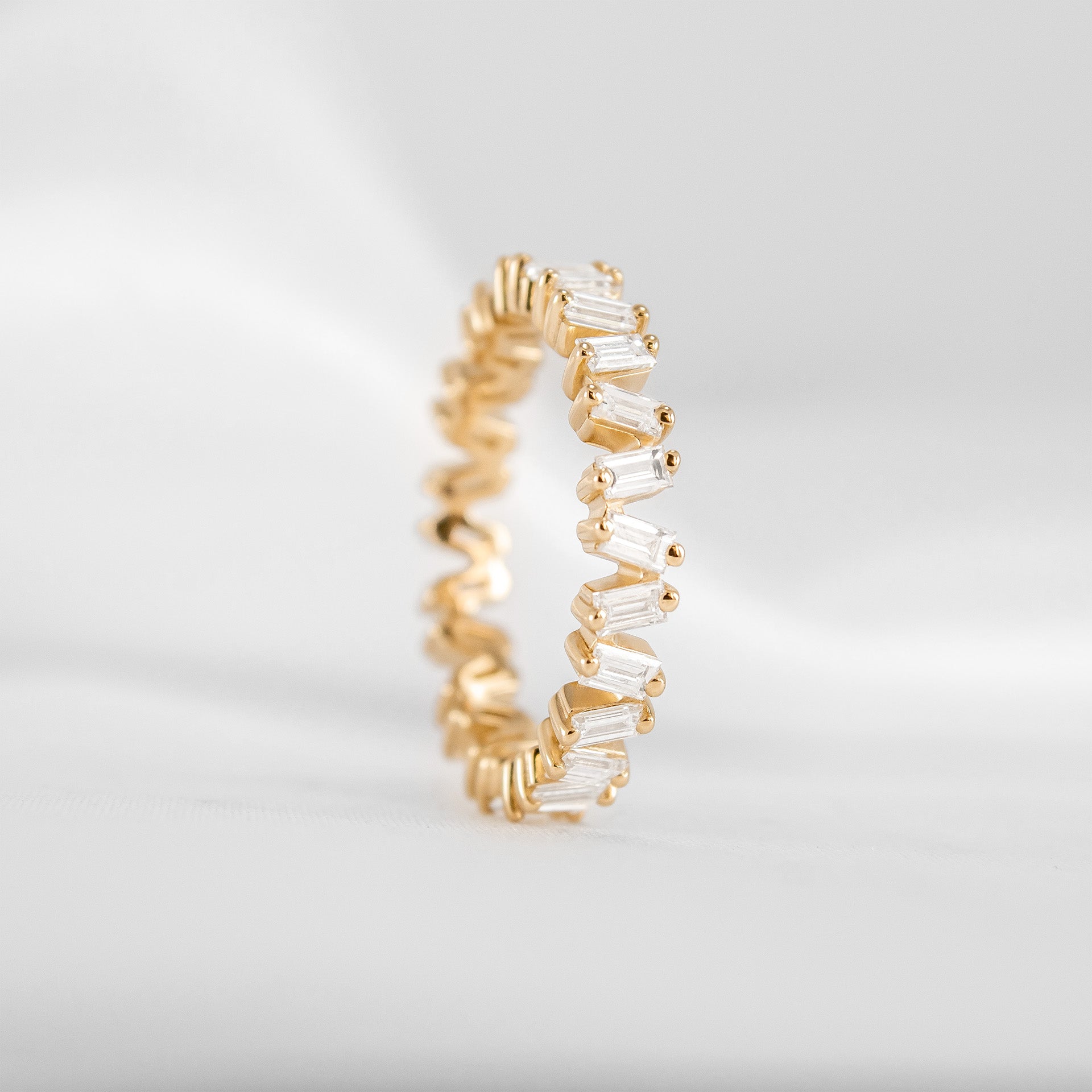
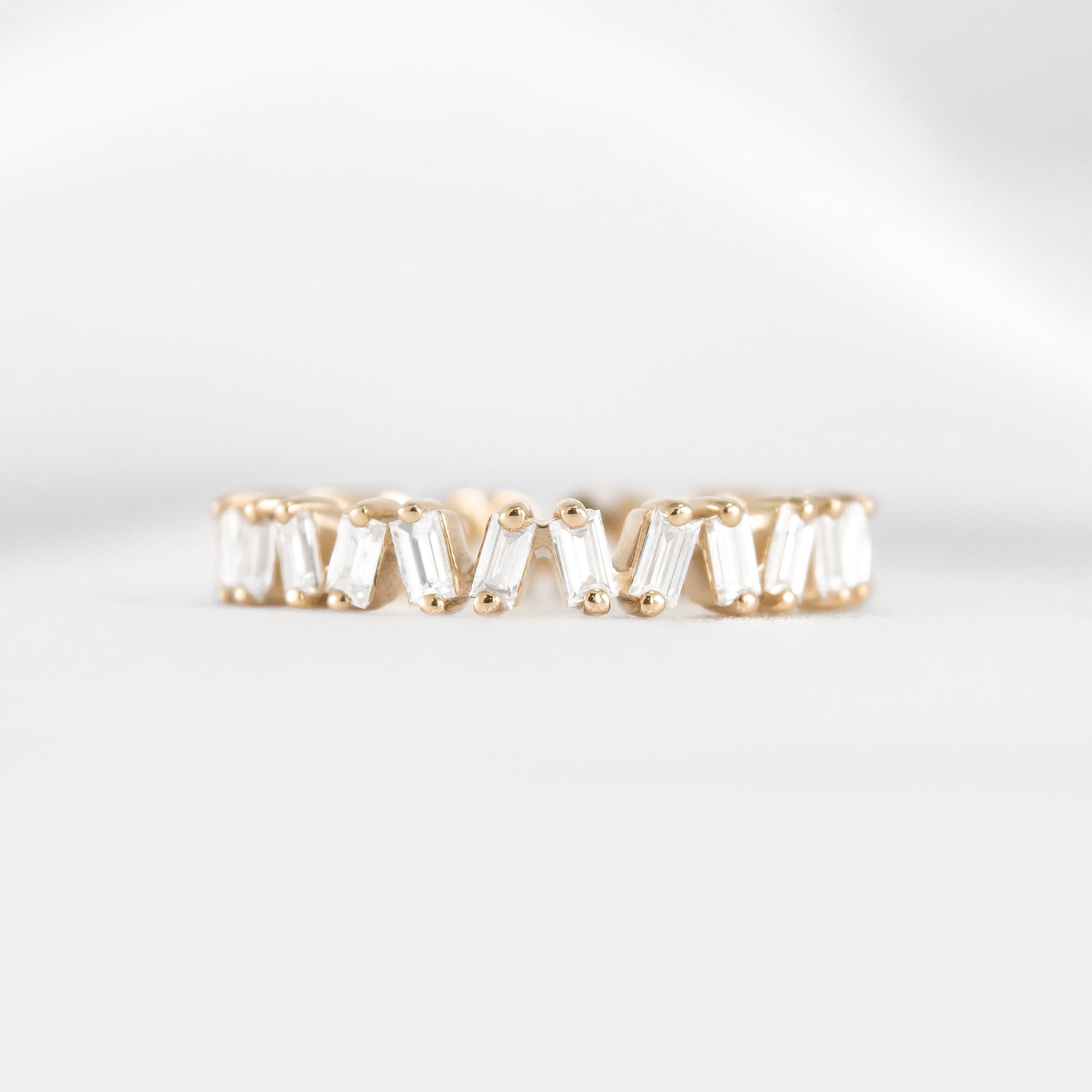
Blaine: A baguette diamond eternity ring with continuous baguette diamonds set around the full circumference. Geometric brilliance through the entire band.
Featured Baguette Diamond Designs
The baguette diamond designs in this collection span eternity bands, tapered wedding rings, and matched wedding sets.
Blaine: A baguette diamond eternity ring with continuous baguette diamonds set around the full circumference. Geometric brilliance through the entire band.
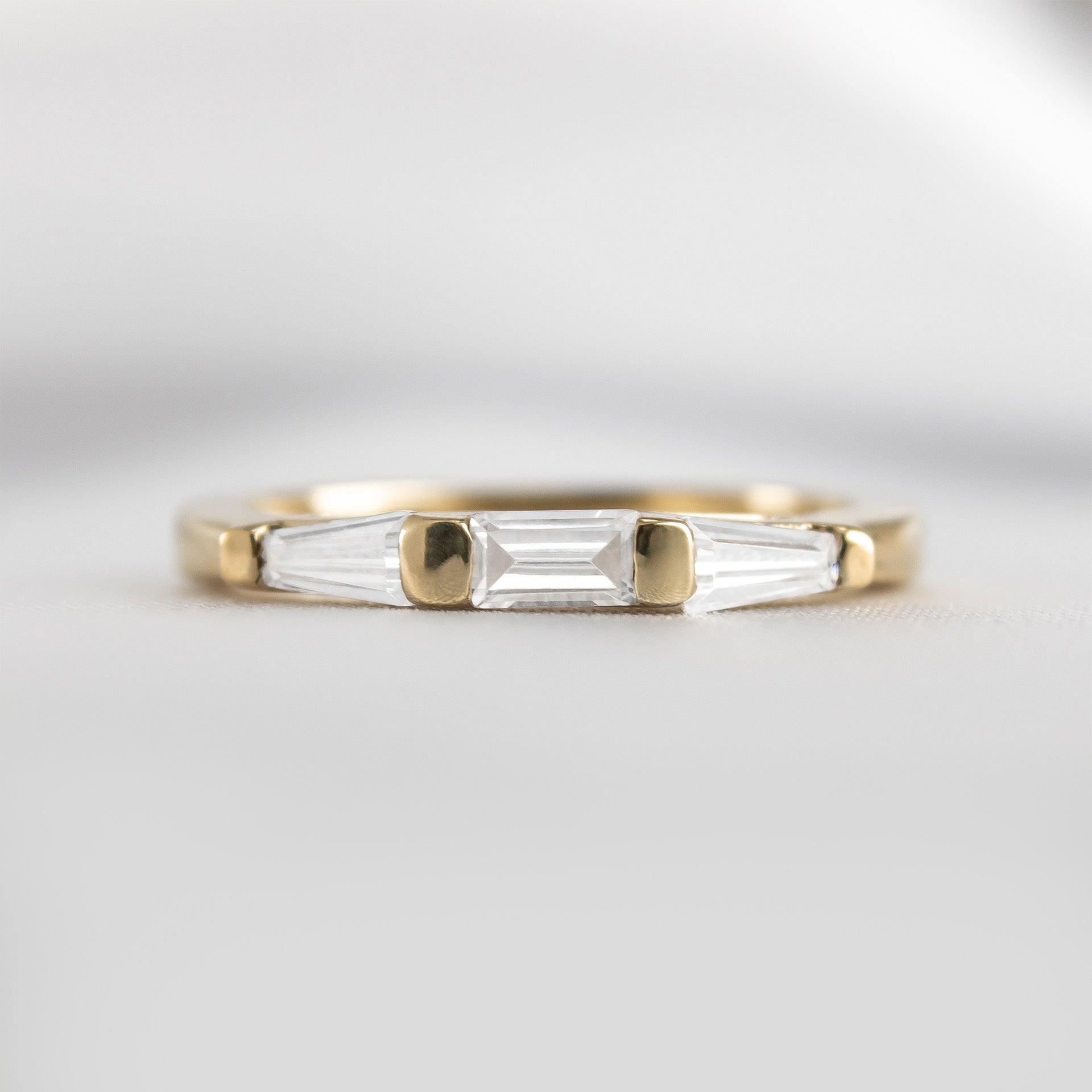
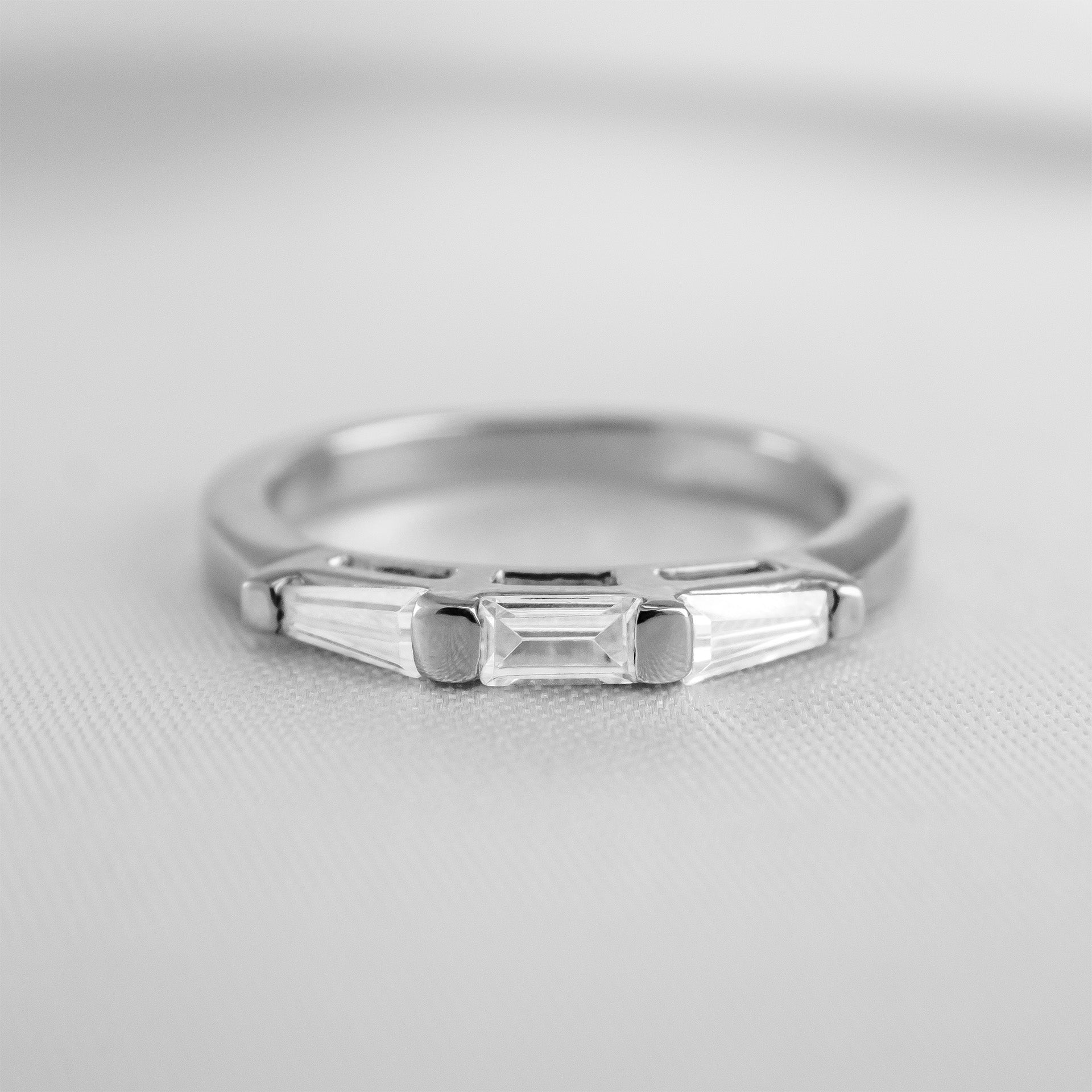
Dillon: A tapered baguette diamond wedding ring with diamonds graduating in size across the band's length. The taper produces dimensional visual movement.
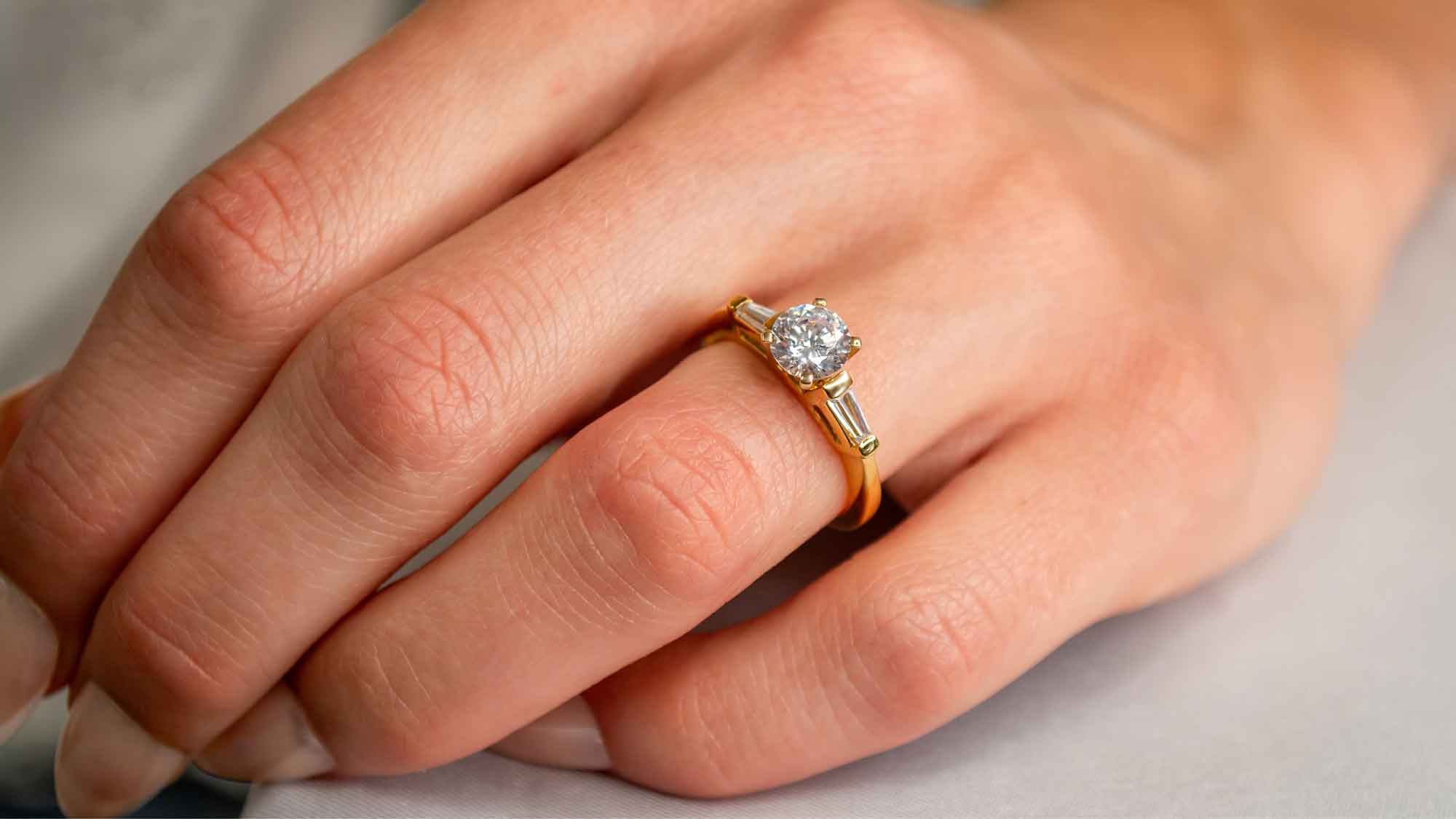
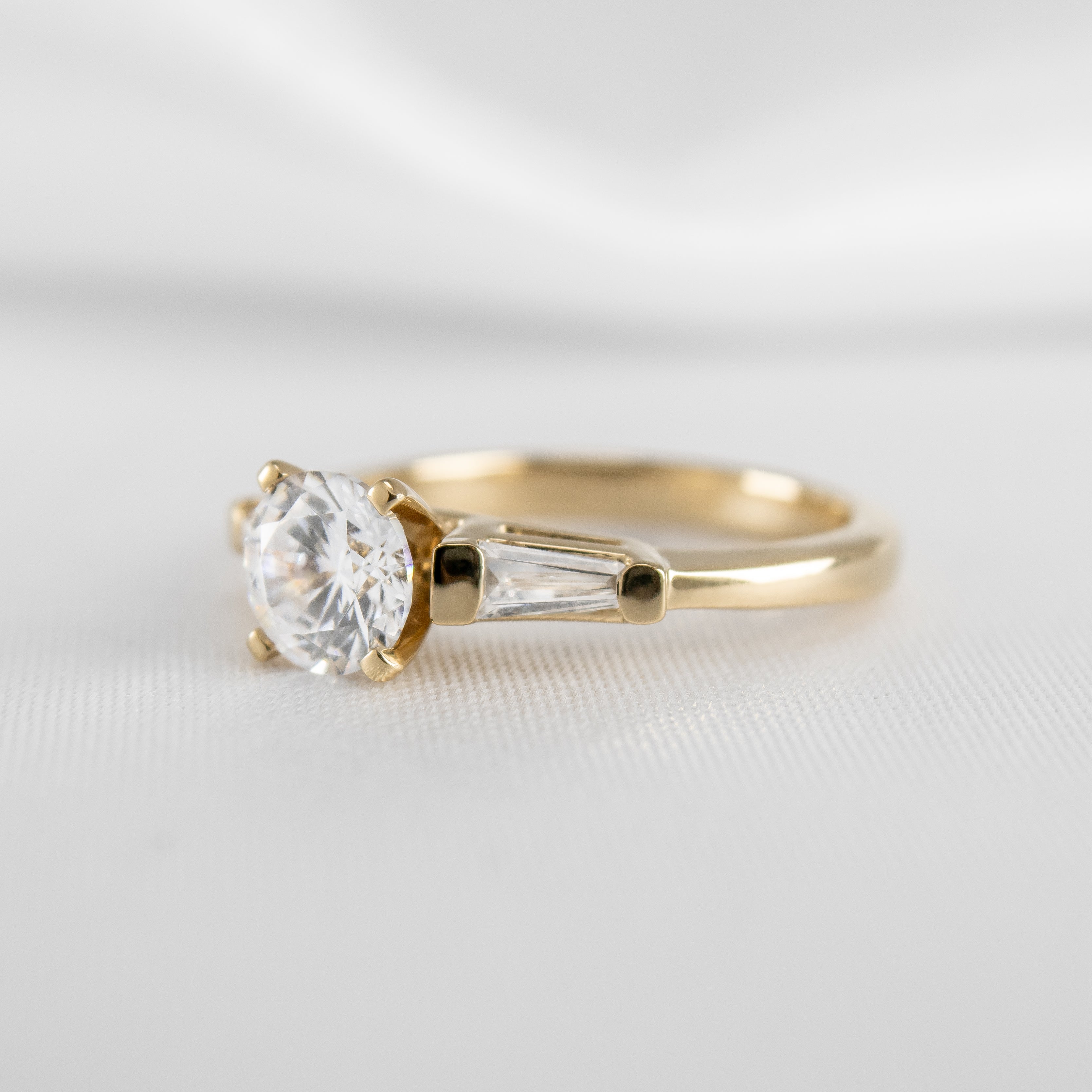
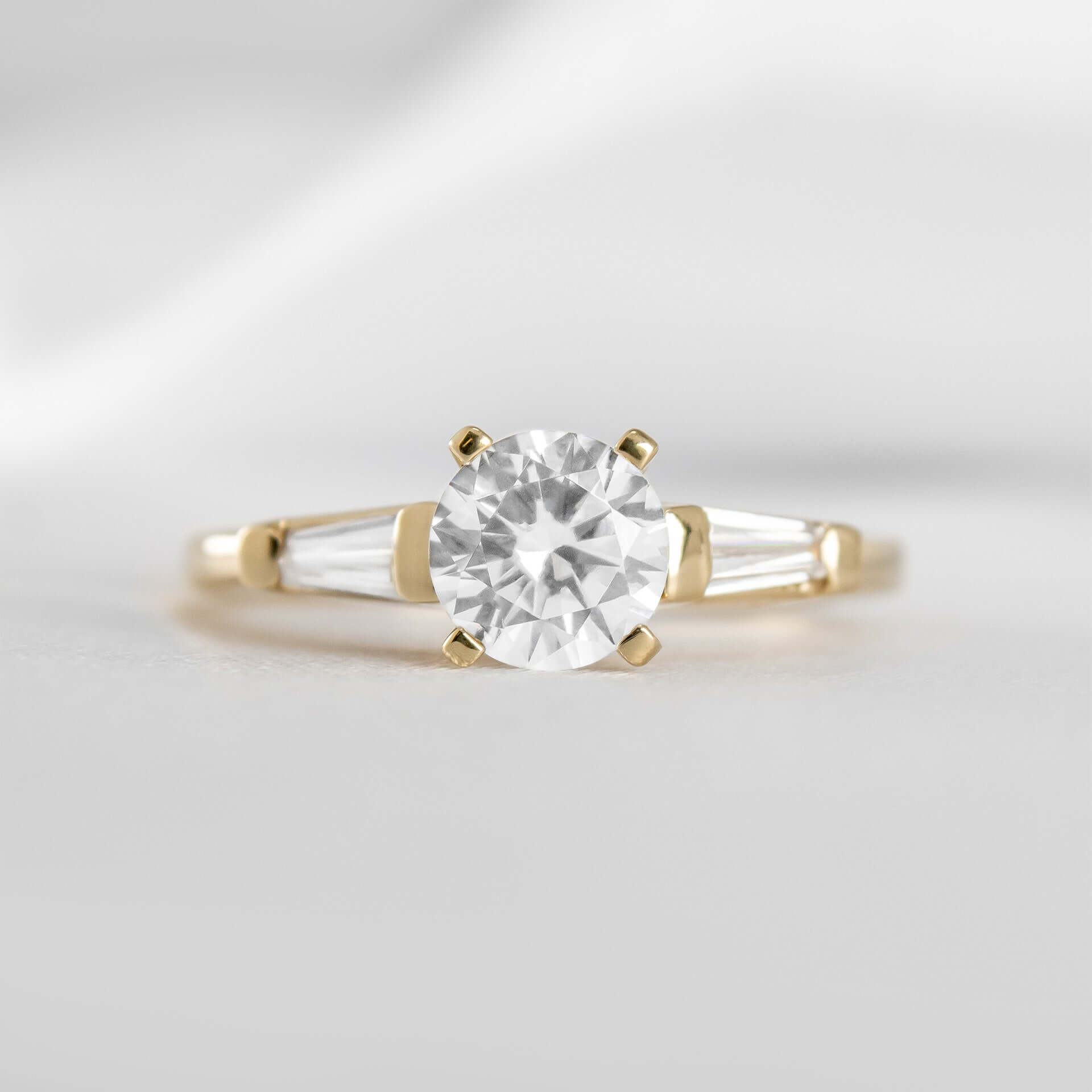
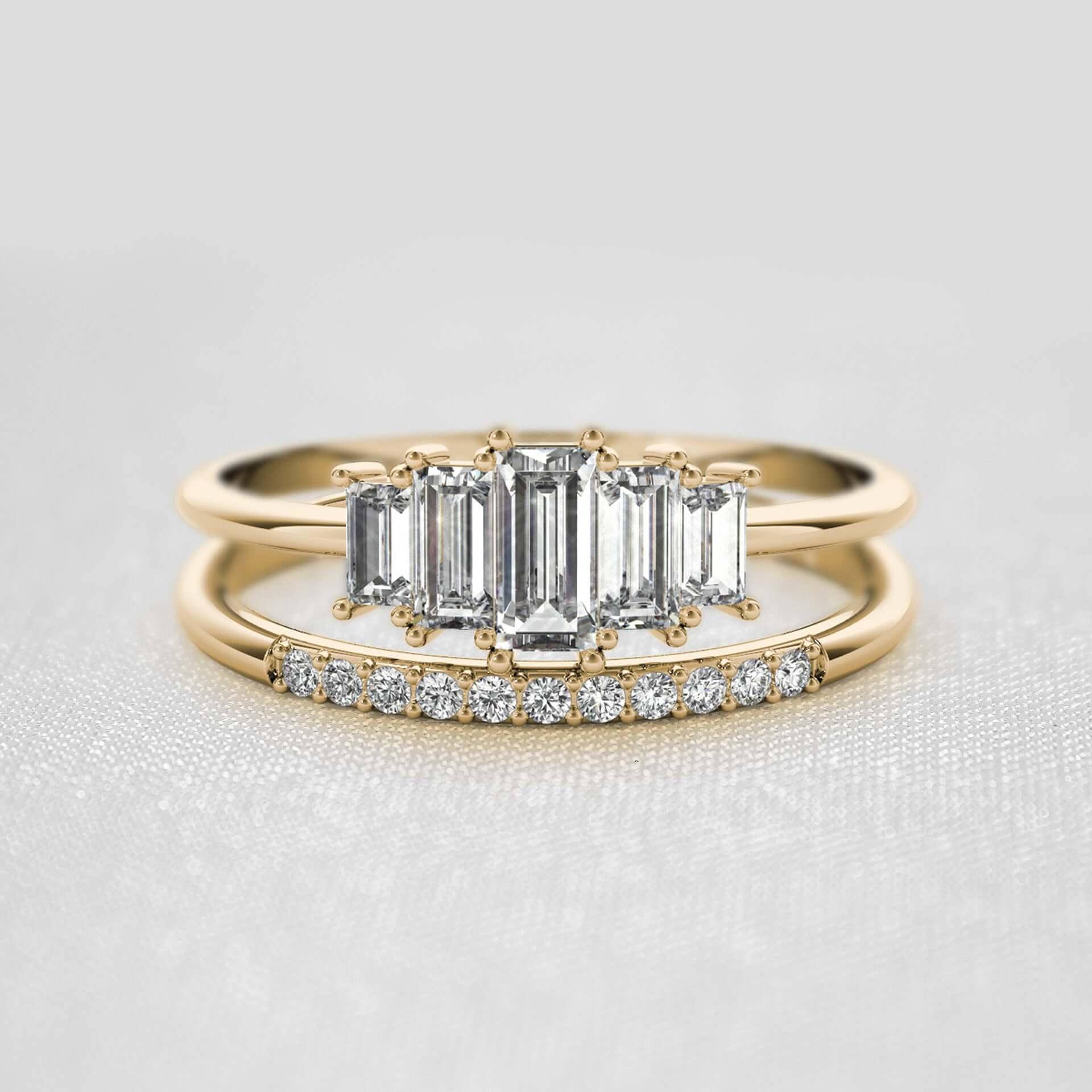
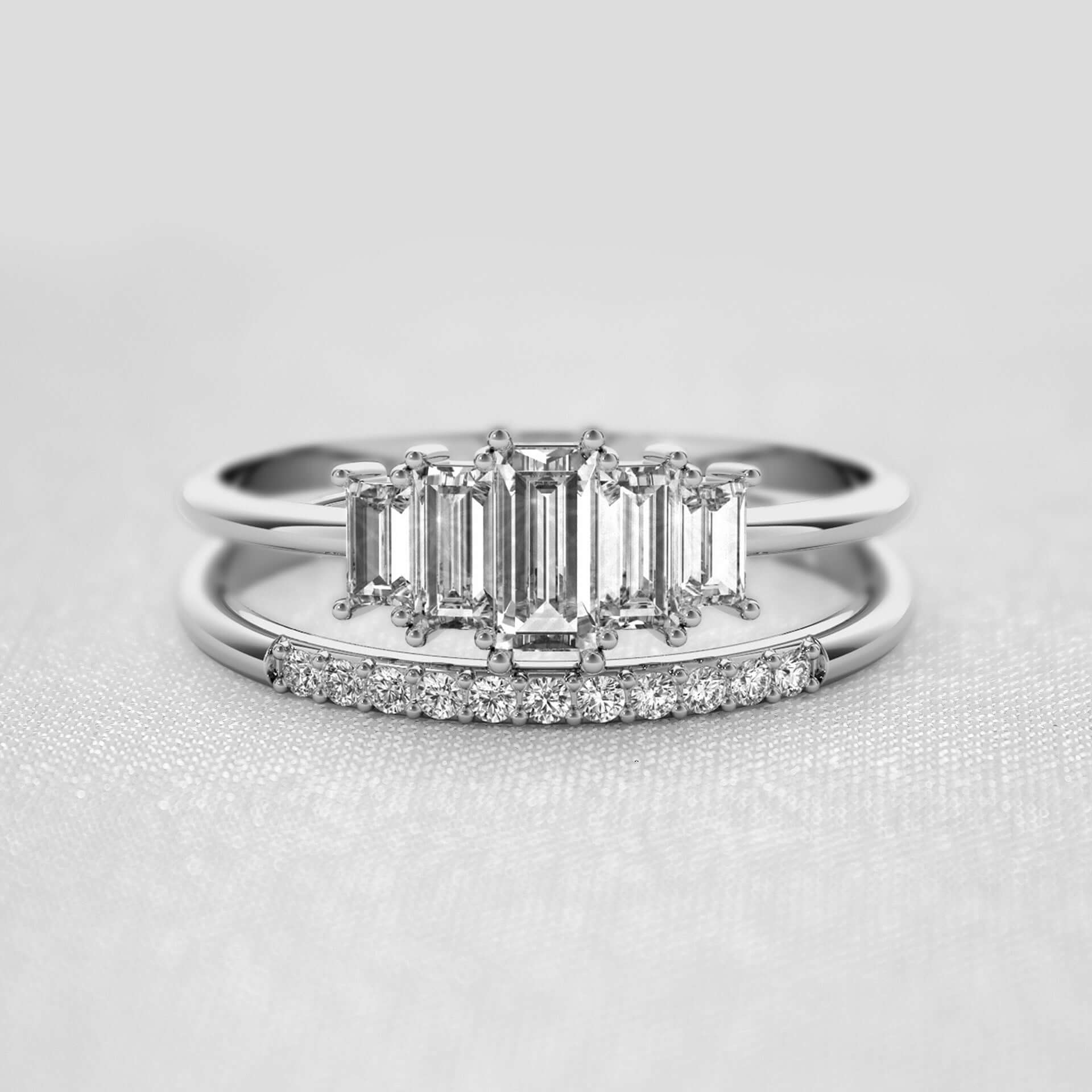
Devon: A three-stone diamond engagement ring with center diamond flanked by baguette side stones. The baguette accents complement the center in art deco vocabulary.
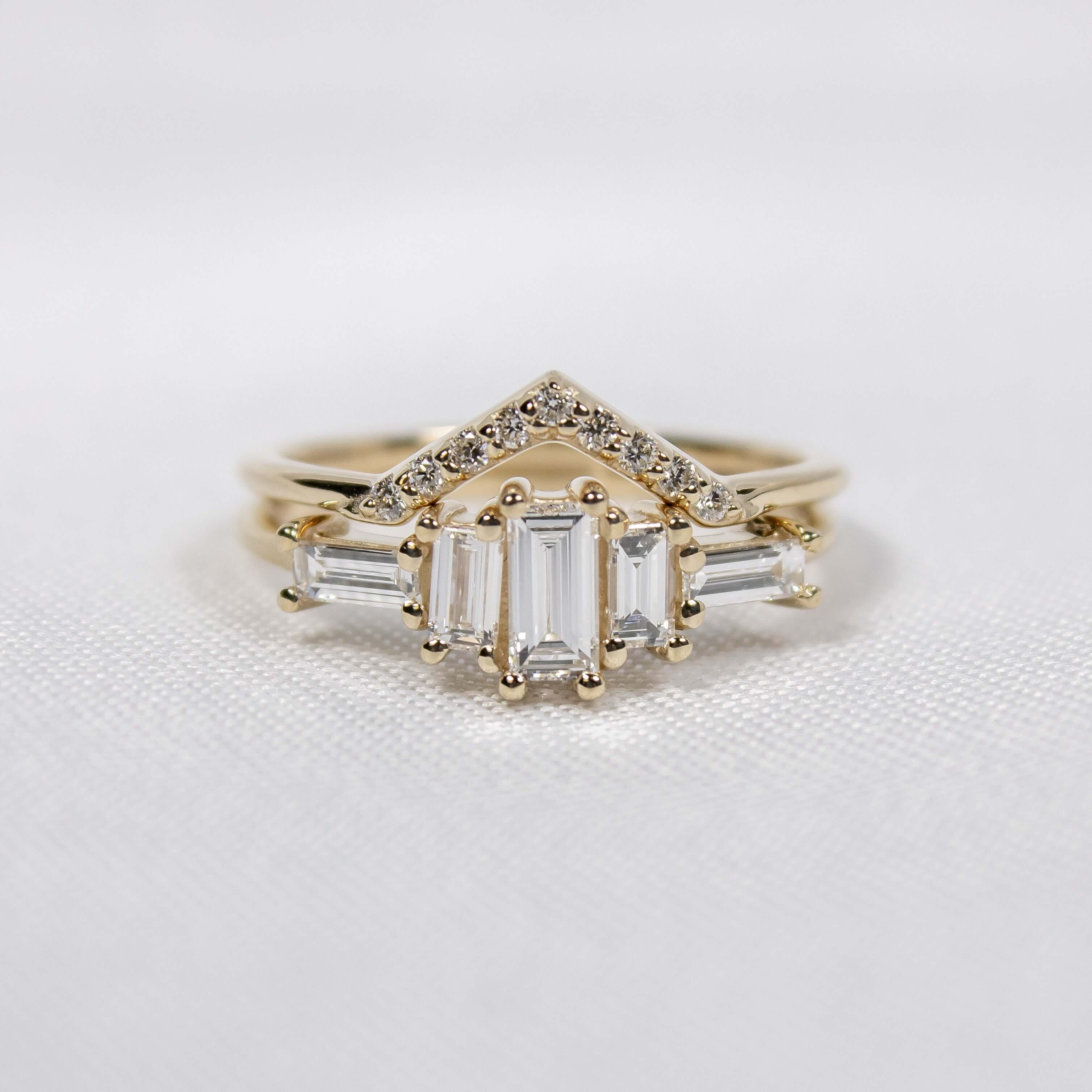
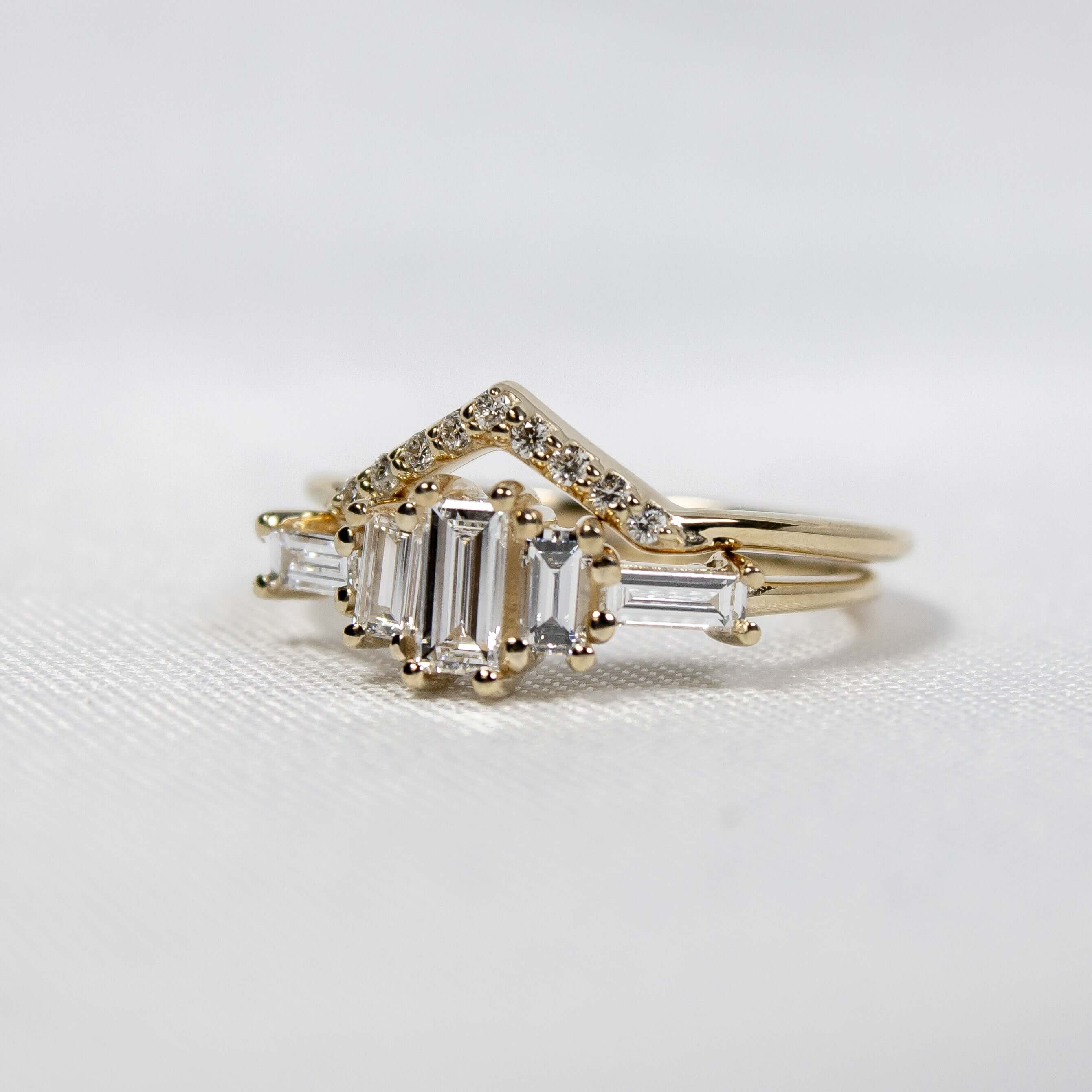
Bellamy: An art deco diamond wedding set featuring baguette diamond construction across the engagement ring's geometric cluster and matched band.
Brooklyn: An art deco wedding set with baguette diamond engagement ring and matched chevron diamond band. Stepped geometric cluster anchors the set.
What is a Baguette Cut Diamond?
The baguette cut is a step-cut diamond — meaning its facets are arranged in parallel rows rather than the brilliant-cut radial pattern used in round and oval diamonds. The result is a rectangular diamond with clean linear character and step-cut faceting that produces architectural light reflection rather than brilliant sparkle.
Baguette diamonds typically have 14 facets — significantly fewer than the 57-58 facets of a brilliant-cut round diamond. The fewer facets mean baguette diamonds don't sparkle the way brilliant cuts do; instead, they produce clean reflective light flashes from their step-cut surfaces. This visual character is intentional — baguettes are chosen for their architectural reflection, not for brilliant sparkle.
Baguettes come in two primary variations. Straight baguettes have parallel sides (rectangular shape). Tapered baguettes have angled sides — wider at one end and narrower at the other, producing a trapezoid shape. Tapered baguettes are commonly used as side stones flanking center diamonds, where the taper directs visual attention toward the center.
Baguette Diamonds in Art Deco Design
Baguette diamonds emerged with art deco jewelry in the 1920s and 1930s — the design period defined by geometric symmetry, architectural composition, and angular construction. Art deco jewelry rejected the flowing organic curves of Victorian and Art Nouveau design in favor of stepped geometric patterns, baguette and step-cut stones, and visible structural lines.
This collection includes designs that draw directly on art deco vocabulary. The Bellamy and Brooklyn wedding sets feature baguette diamond construction in geometric clusters and chevron bands — explicit art deco design language. The Blaine and Dillon use baguettes in eternity and tapered formats that nod to art deco without being strictly period-specific.
For couples drawn to art deco aesthetics — clean geometric lines, architectural composition, baguette and emerald cut diamonds, milgrain edge detail — these baguette designs read as deliberate period reference rather than generic modern wedding bands.
Pairing Baguette Wedding Bands with Engagement Rings
Baguette diamond wedding bands pair most naturally with engagement rings sharing geometric or step-cut design vocabulary.
With emerald cut and asscher cut engagement rings: Both engagement ring centers are step-cut diamonds — same faceting family as baguettes. The wedding band's baguette diamonds continue the step-cut vocabulary across both rings, reading as a coordinated step-cut pair.
With baguette center engagement rings: Engagement rings that use baguette diamonds as center stones (like the Brooklyn) pair naturally with baguette wedding bands. The shape and faceting continue without interruption from center to band.
With three-stone engagement rings featuring baguette accents: The Devon and similar three-stone designs use baguette side stones flanking a center diamond. Pairing these with a baguette wedding band creates a coherent baguette vocabulary across the engagement ring and the band.
With round or oval brilliant center engagement rings: Baguette wedding bands work alongside brilliant-cut center engagement rings as a deliberate vocabulary mix — brilliant cut for the engagement ring's focal sparkle, baguettes for the wedding band's architectural reflection. This pairing reads contemporary and can be intentional when both rings stand on their own.
Choosing Straight, Tapered, or Mixed Baguette Designs
Baguette wedding bands can use straight baguettes, tapered baguettes, or a mix of both. The choice affects visual character significantly.
Straight baguette wedding bands: Baguette diamonds with parallel sides arranged in continuous rectangular pattern. The Blaine uses straight baguettes for its eternity band — reading as a continuous architectural diamond pattern around the finger. Straight baguettes work best when the visual goal is uniform geometric repetition.
Tapered baguette wedding bands: Baguette diamonds with angled sides that graduate in size or shape across the band. The Dillon uses tapered baguettes for visual movement — the diamonds graduate from larger to smaller (or vice versa) across the band's length, producing directional emphasis.
Mixed baguette designs: Some art deco wedding rings combine baguettes with other diamond cuts (round brilliants, princess cuts) in a single design. The Brooklyn and Bellamy use this approach — baguettes anchor the geometric structure while other diamond cuts add brilliance and visual texture.
The choice depends on whether the goal is uniform architectural repetition (straight), directional movement (tapered), or mixed-vocabulary art deco composition (mixed).
Customizing Your Baguette Diamond Wedding Band
Baguette diamond wedding bands in this collection are made-to-order with customization at multiple levels.
Metal choice: 14K gold (yellow, white, or rose) or platinum. Some art deco designs in this collection are 14K gold only — typically those with specific design elements that work in gold alloys but not in platinum.
Diamond origin and quality: All baguette diamonds can be specified as lab grown or natural. Standard clarity is VS-SI1 in E-F-G color. Higher clarity and color is available at increased pricing.
Diamond proportions: Baguette dimensions can be adjusted within the design's structural constraints. The Dillon's tapered baguettes, for example, can be specified with steeper or shallower taper depending on the visual character you want.
Engraving: Interior engraving is available at no additional charge on all baguette wedding bands.
Custom baguette designs: For couples wanting baguette wedding bands or engagement rings outside this collection — different art deco compositions, different baguette arrangements, mixed-cut designs — Lisa designs custom baguette work through a private design appointment.
Care and Service for Baguette Diamond Wedding Bands
Baguette diamonds are step-cut stones with clean corners — the corners can chip under direct impact, similar to emerald cut and asscher cut diamonds. To address this, baguette diamonds in wedding bands are typically channel-set (held between metal walls) or bezel-set (surrounded by metal frame) rather than prong-set. Both setting styles protect the corners.
For routine care: remove the ring before heavy manual work, gym workouts with weights, gardening, and activities involving harsh chemicals. Clean weekly with warm soapy water and a soft cloth. Annual professional cleaning keeps the step-cut faceting bright — accumulated oils and residue particularly dull baguette diamonds because their step-cut surfaces are visually exposed.
Baguette diamond wedding bands can typically be resized within a reasonable range, with the caveat that full eternity baguette bands (like the Blaine) generally cannot be resized because diamonds run around the entire circumference. Half eternity baguette bands and partial-diamond designs (like the Dillon, Devon) resize within 2-3 sizes up or down. We handle all resizing through our New York workshop.
Baguette Diamond Wedding Bands and Engagement Rings — Frequently Asked Questions
