



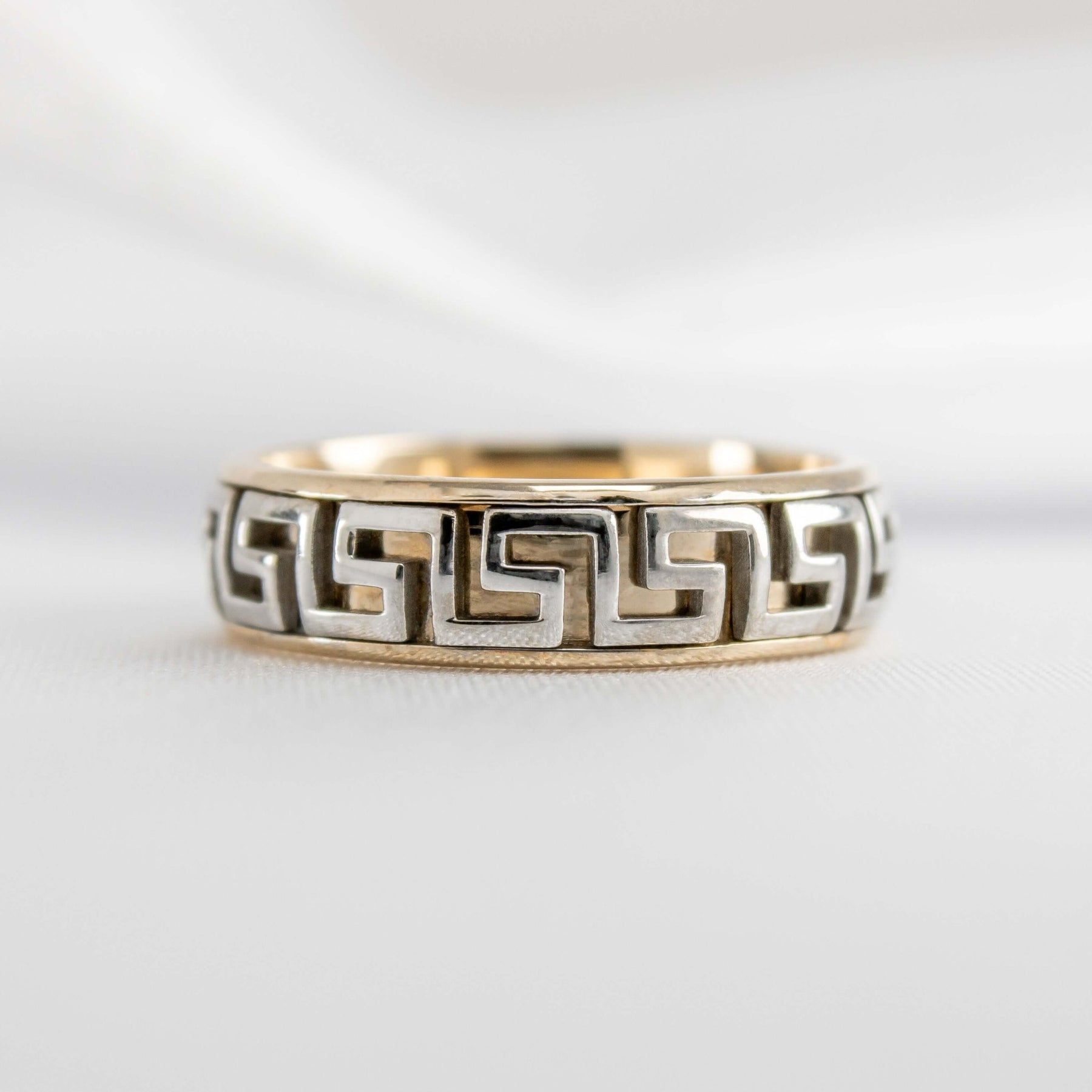
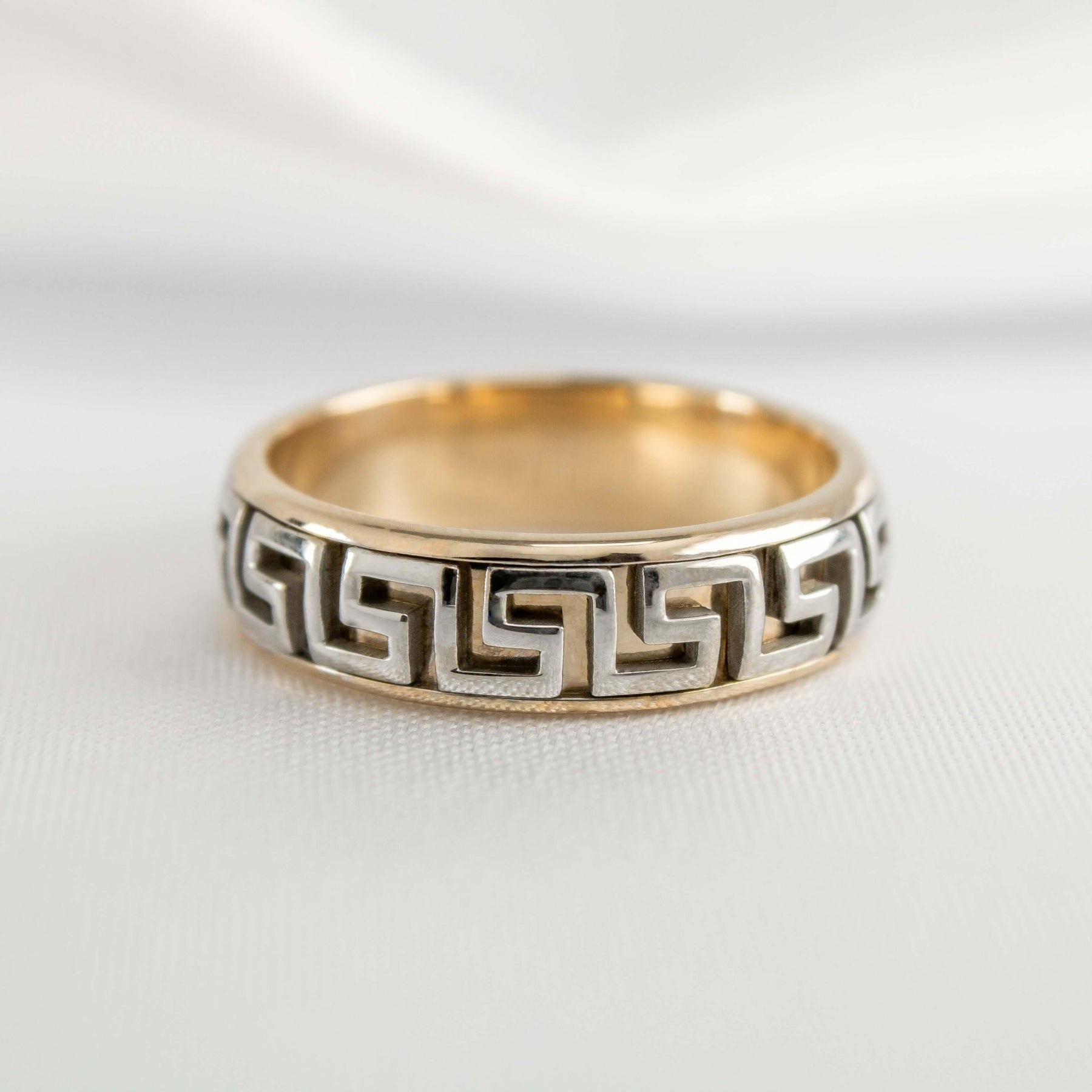
The Adam Greek Key 14K yellow gold wedding ring by Lisa Robin
The Adam Greek Key 14K yellow gold wedding ring by Lisa Robin on model square
The Adam Greek Key 14K yellow gold wedding ring from top view by Lisa Robin
The Adam Greek Key 14K yellow gold wedding ring from angle by Lisa Robin

The Adam Greek Key Wedding Ring

The Adam is a greek key wedding ring with a continuous meander pattern precision-engraved across a 6mm comfort-fit domed band. A greek key band carrying one of the oldest decorative motifs in Western history — the same interlocking spiral found on ancient pottery and neoclassical architecture.
Regular price$ 5,495.00
/

The greek key pattern on the Adam is engraved into the 6mm band face — precision-cut square-cornered spirals that interlock and repeat around the full circumference. The engraving creates a graphic, high-contrast surface that reads specifically as the Greek meander: the pattern found on ancient pottery, Ionic column bases, and neoclassical architecture.

In yellow gold, the greek key band reads closest to its classical precedent — the warm metal amplifies the historical associations. In white gold or platinum, the same greek pattern wedding ring reads sharper and more contemporary. The 6mm width gives the meander enough room to develop legibly.

Metal Options 14K Yellow Gold, 14K White Gold, 14K Rose Gold, or Platinum. Sustainably sourced.
Setting Diamond Total Weight None
Style Greek key wedding ring, engraved
Band 6mm
Setting Height N/A
Band Profile Domed, comfort fit, engraved greek key
Crafting Time Approximately 2-3 weeks

The Adam Greek Key Wedding Ring starts at $895 in 14K gold.

What is the greek key pattern and what does it symbolize?

The greek key, or meander, is an ancient decorative motif consisting of interlocking square-cornered spirals that run in a continuous line without interruption. It originated in Greek art before 700 BCE and was named after the Maeander River in Anatolia, whose winding course the pattern resembles. The motif has been interpreted as symbolizing infinity, eternity, and continuity — the pattern has no beginning and no end. It's also simply recognized as beautiful geometric design. Both the symbolic and the aesthetic readings make it appropriate for a wedding ring.

Does an engraved wedding ring show wear over time?

An engraved surface accumulates fine scratches with daily wear the same way any polished metal surface does. On the Adam, the engraving itself runs relatively deep into the band surface, which means the greek key pattern remains legible even as the surface develops a patina. Surface wear on an engraved ring typically gives it more character rather than diminishing the design — the fine scratches integrate with the engraved lines rather than obliterating them. The band can be professionally re-polished and re-engraved if needed, though most people prefer the worn look after a few years of daily wear.

What ring widths work best for engraved patterns like the greek key?

Engraved geometric patterns like the greek key require sufficient band width to read clearly on the finger. At narrow widths (2-3mm), the pattern becomes too compressed to show its interlocking character and reads as texture rather than motif. The Adam is sized at 6mm, which gives the meander pattern enough surface to develop a full repeat of the interlocking spirals. Most engraved band patterns work best at 5mm or wider — the specific minimum depends on the pattern's complexity and repeat size.

Our guided approach to customizing each ring with intention and clarity.

Every Lisa Robin ring is made to order, which means your design can be thoughtfully refined—even when ordering online. Whether you’re adjusting a detail or evolving the design, we guide you through each decision to ensure the final piece feels cohesive and entirely yours.

Design Refinements can be explored after your initial order, with any pricing adjustments clearly outlined and approved before crafting begins.

Refinement options include but are not limited to:

  • Adjusting the width or taper of the band (shank)
  • Modifying or adding details
  • Adding gemstones or diamonds
  • Selecting your preferred metal type and color

Made to order Ships Aug 15 to Aug 22
Shipping costs calculated at checkout

The Adam Greek Key Wedding Ring

The meander pattern appeared on Greek pottery before 700 BCE and hasn't disappeared from Western design since — you can find it on ancient columns, Renaissance architecture, Edwardian silverware, and contemporary fashion in the same uninterrupted continuous sequence.

Engraved across the 6mm comfort-fit band of the Adam, the greek key wedding ring carries the full meander around its circumference. The pattern's square-cornered interlocking spirals repeat without beginning or end — the same logic that makes it read as eternal. The greek key band doesn't need explanation or context; the pattern is too old and too widely applied to feel obscure or precious. It's a design decision with thousands of years of precedent.

The Adam joins a Lisa Robin tradition of engraved and motif-driven wedding rings designed for couples drawn to design with deep historical roots.

Design Process

The Lisa Robin Wedding Band Experience

A thoughtful process designed to bring clarity and confidence to the creation of your wedding band.

Our collection is intentionally edited — each gold band reflects a distinct point of view, with proportions, profiles, and finishes that set it apart from what you've likely been seeing online.

When something here resonates, the decision tends to feel clear.

From there, we guide you in refining the details to align the design with your preferences.

Once you've chosen your wedding band, you'll select the core elements that define the design:

  • Metal type
  • Band width and profile
  • Finish — polished, matte, or brushed
  • Finger size
  • Optional engraving

If your wedding band will be worn alongside an engagement ring, we can help you evaluate how the proportions and overall profile will sit together and feel over time.

These decisions are focused and straightforward — so you can move forward with clarity.

If you'd like to adjust your gold wedding band, we guide you through a thoughtful refinement process — ensuring any changes support the overall balance and feel of the design.

Common refinements may include:

  • Adjusting band width or profile
  • Changing the finish or surface texture
  • Subtle modifications to improve pairing or wearability

Each change is considered within the context of the full design, so the final ring feels cohesive and intentional from every angle.

For custom refinements, we provide renderings for review before crafting begins — so you can move forward with complete confidence.

Every custom wedding band is hand-crafted to order based on your final selections.

  • Crafted specifically for your chosen design and refinements
  • No pre-made inventory or resizing shortcuts
  • Typical timeline: 2–3 weeks

If additional clarity is helpful before crafting begins, we can guide you through the next steps to ensure everything feels aligned.

What our customers say

I am very pleased with the Adam Greek Key men’s wedding ring—it exceeded my expectations. The craftsmanship is exceptional, featuring a timeless and detailed design.
The ring carries a meaningful sense of symbolism, representing strength and commitment. I have received numerous compliments on it. It is an excellent choice for anyone seeking an elegant, distinctive, and durable piece.

Adam & Mary Katherine
Nashville TN

I loved working with Lisa Robin! It was so easy to create exactly what I wanted. With some minor changes to Lisa's gorgeous styles, I had the perfect wedding ring to coordinate with my Lisa Robin Engagement Ring. Can’t wait to add another ring to my stack.

Abby & Zane
Blountville TN

Men's Wedding Bands — Frequently Asked Questions

The terms 'wedding ring' and 'wedding band' are used interchangeably in everyday conversation — both refer to the wedding ring worn on the finger to mark marriage. In this collection, we use 'wedding band' to describe the precious metal (gold and platinum) wedding rings specifically — emphasizing the band form itself rather than diamond detail. The broader 'men's wedding rings' category includes alternative metals (ceramic, tungsten, titanium), diamond-set wedding rings, and all wedding ring styles. So all 12 wedding bands in this collection are also wedding rings; not all 32 men's wedding rings in the broader collection are wedding bands in this specific sense.
Common widths for men's wedding bands range from 4mm to 10mm. 4mm is refined for smaller hands or men preferring a less prominent band. 6mm is the most chosen width — substantial without being statement scale. 8mm is the traditional men's wedding band width — clearly masculine, substantial daily presence. 10mm is statement scale, the maximum standard width. The choice depends on hand proportion and personal preference. Most men choose 6mm or 8mm. The Tanner family offers all five widths (2mm, 4mm, 6mm, 8mm, 10mm) so couples can match different widths to each partner's hand.
14K gold is 58.3% pure gold (the rest is alloyed metals for hardness); 18K gold is 75% pure gold. 14K is the standard for fine jewelry in the United States — it balances gold color richness with practical durability. 18K has richer gold color (more saturation) but is slightly softer due to higher pure gold content; it may show minor surface marks more easily than 14K. For daily-wear men's wedding bands, 14K is the practical choice; for maximum color richness, 18K. Yellow gold shows the color difference between 14K and 18K most clearly; white gold and rose gold are less affected by karat level. Platinum is a different alloy entirely and is the most durable of the precious metal options.
Yellow gold reads warm and traditional, works on most skin tones, and is the most chosen color for plain men's wedding bands. White gold reads cool and modern, coordinates with platinum and white gold engagement rings (if pairing with your partner's ring), and may require periodic rhodium replating to maintain the brightest white finish. Rose gold reads warm pink and contemporary — increasingly popular for modern wedding bands. The choice often comes down to personal preference, whether the band needs to coordinate with other rings, and skin tone. Yellow flatters warmer skin tones; white and platinum flatter cooler skin tones; rose gold works across both.
All metals develop minor surface marks over years of daily wear. Polished gold (yellow, white, rose) and polished platinum show light surface marks most visibly because the high polish reflects light cleanly — any disruption shows. Hammered, brushed, or patterned surfaces hide minor marking because the texture itself produces visual interest that masks individual scratches. Annual professional polishing (free for any ring we've crafted) restores the original surface. For men in trades, manual labor, or active lifestyles, textured surfaces (hammered Townes, brushed Milo) or alternative metal wedding rings provide significantly better daily marking resistance than polished gold or platinum.
Yes. The Tanner family is particularly suited for matched couples' bands because it offers five widths in the same design vocabulary. Couples often choose different widths for each partner from the same Tanner family — for example, 4mm Tanner for one partner and 6mm or 8mm Tanner for the other. The shared design language reads coordinated; the width difference accommodates each partner's hand. Other matched options include same-width different-metal pairs, or coordinated designs where one partner chooses Tanner and the other chooses a designed wedding band that complements without exactly matching. We discuss matched options during a joint design appointment.
Yes. Interior engraving is available on all men's wedding bands in this collection and is included at no additional charge. Standard engraving accommodates 30-50 characters depending on band width and font choice. Typical engravings are the wedding date, initials, a short phrase, coordinates, or anything personally meaningful. For longer engravings or specific font requests, we discuss options during the order conversation. Exterior engraving (decorative scrollwork, monograms, or extended phrases on the outside of the band) is available for additional cost depending on complexity. Engraving adds approximately 1 week to the crafting timeline.
Yes. Men's wedding bands in gold or platinum can be resized within a reasonable range — typically 4-5 sizes up or down for plain Tanner bands, 2-3 sizes for designed bands with specific profiles, patterns, or surface treatments. The resize involves cutting through the band, adjusting the diameter, rejoining the metal, and refinishing. For bands with specific surface treatments (hammered Townes, brushed Milo, Greek key Adam), the resize work requires careful preservation of the original surface character. All resizing on rings we've crafted is handled through our New York workshop; we maintain records of every ring we make to support future service indefinitely.
Men's wedding bands in this collection are made-to-order in approximately 2-3 weeks from when your order is placed. The Tanner family typically finishes at the faster end (2 weeks); designed wedding bands (Flynn, Jamie, Townes, Milo, etc.) typically take the full 2-3 weeks. Custom men's wedding band designs take 3-4 weeks from design approval. Interior engraving adds approximately 1 week to the timeline. For wedding date deadlines, confirm timeline during the order conversation and we'll let you know if rush options are available.
Pricing depends on karat, metal color, width, and design complexity. Plain Tanner wedding bands range $700-$2,400 depending on width and karat (the 10mm 18K Tanner is at the upper end). Designed men's wedding bands (Flynn, Jamie, Adam, Townes, Percy, Kennedy, Milo) range $1,200-$2,800. Platinum versions of the same designs add approximately $400-$800 over the 14K gold price; 18K gold adds approximately $200-$400. Hand engraving or custom designs may add modest additional cost. Specific pricing is confirmed during the order conversation based on your karat, color, width, and engraving specifications.